


Three fresh Bluetooth headsets are on the way from Samsung: the WEP850, WEP870, and WEP470. The first on the left, the WEP870, is a compact mono headset that can be connected with a stereo earbud if you’re listening to music rather than taking calls, and can pair up with two devices simultaneously for those packing a utility belt-worth of phones. It’ll be going for $89.99. The middle headset, the WEP850, focuses primarily on noise cancellation, and runs for $69.99. Not bad if you’re looking for something a little sleeker. Finally, the WEP470 is more basic at the $39.99 price point, but emulates dual-microphone noise cancellation through some black magic they call “packet loss concealment”.
Showing posts with label Headset. Show all posts
Showing posts with label Headset. Show all posts

Sony Ericsson has recently unveiled a new accessory - Portable Handsfree MH700. We haven’t caught the press release, but when it comes to Sony Ericsson matters, we look at the SEMC blog, which does a great job in covering the Swedish-Japanese company. From there we found out the MH700 comes with two 3.5mm audio jacks along with a fast-port connector. According to SEMC, the stylish handsfree will best sing along some high-end device such as the Xperia X1 or W995 Walkman.
As of the time of this writing, we’ve no information when will the Sony Ericsson Portable Handsfree MH700 start selling, nor how much it will cost. As soon as we hear something new, we’ll let you know. Stay tuned in the meantime…
mobile phone cellular gadget technology fashion style tips & gossip parenting shoes sneaker sport stuff
Headset
|
 Jabra have announced two new Bluetooth devices, the HALO Stereo Headset and the SP200 Speakerphone. Jabra’s HALO stereo wireless headset features what the company calls Noise Blackout technology. The Jabra HALO is a wireless Bluetooth stereo headset for music lovers that allows users to switch between their favorite tunes and important phone calls. The headsetwith has A2DP technology, includes 3.5 mm music playing devices.
The Jabra SP200 speakerphone connects wirelessly to mobile devices with Bluetooth technology, and features an accessible control button and volume wheel. will give you 10 hours of talk time, 23 days of standby, and active noise reduction. The SP200 supports full duplex audio and both the headset and hands-free Bluetooth profiles.
The Jabra HALO stereo headset will be available for $129.99 in May, while the Jabra SP200 speakerphone will be available for $59.99 in April.
Headset
|
Jabra have announced two new Bluetooth devices, the HALO Stereo Headset and the SP200 Speakerphone. Jabra’s HALO stereo wireless headset features what the company calls Noise Blackout technology. The Jabra HALO is a wireless Bluetooth stereo headset for music lovers that allows users to switch between their favorite tunes and important phone calls. The headsetwith has A2DP technology, includes 3.5 mm music playing devices.The Jabra SP200 speakerphone connects wirelessly to mobile devices with Bluetooth technology, and features an accessible control button and volume wheel. will give you 10 hours of talk time, 23 days of standby, and active noise reduction. The SP200 supports full duplex audio and both the headset and hands-free Bluetooth profiles.
The Jabra HALO stereo headset will be available for $129.99 in May, while the Jabra SP200 speakerphone will be available for $59.99 in April.
Headset
|
USBfever just launched a Mini Microphone for iPhone 3G, enabling users to get better sound recording quality on their iPhone. Journalists, students, teachers or researchers probably need this tiny gadget.

- Plug and Play.
- High Quality Microphone, fine sensibility.
- Small and portable.
- No need battery.
- So conveninent, you can wear it as a necklace.
- As a capsule, so compact and lightweight.
As the site's company noticed, for iPhone 3G, you need to download and install software (like iTalk Recorder or Easy Recorder) to your iPhone first.

It can be bought for USD $14.99 (plus international shipping cost USD $2.99 per order) from their website.
You've heard of a hub before, right? Well, in case you haven't, a hub is a device you can use with your computer to hook up other devices and gadgets you may use (such as a keyboard, a mouse, a digital camera, a printer, etc). The most common form of a hub is in a USB format. With that, you simply plug the hub into one of your USB ports and the rest of the devices are hooked into that, which gives them power to work.
So, now that you know all about hubs, what about a wireless hub? Is there such a thing? There sure is and it's very convenient! If you have a wireless network set up in your home or office, you can use a wireless hub to connect all the other devices you need to use. A wireless hub is the perfect way to link everything together with all the computers you use within your network. Along with being inexpensive, wireless hubs are also very easy to set up and configure, which is always a bonus!
The only thing you can't share on a wireless hub is an Internet connection. That's often misunderstood by several people. Even though you have a hub set up on your wireless network, only one computer can access the Internet. If you wanted to share the Internet connection, you would have to purchase a router. Happy hubbing, my friends!
So, now that you know all about hubs, what about a wireless hub? Is there such a thing? There sure is and it's very convenient! If you have a wireless network set up in your home or office, you can use a wireless hub to connect all the other devices you need to use. A wireless hub is the perfect way to link everything together with all the computers you use within your network. Along with being inexpensive, wireless hubs are also very easy to set up and configure, which is always a bonus!
The only thing you can't share on a wireless hub is an Internet connection. That's often misunderstood by several people. Even though you have a hub set up on your wireless network, only one computer can access the Internet. If you wanted to share the Internet connection, you would have to purchase a router. Happy hubbing, my friends!
Headset
|

I’m not sure why but lately I’ve becoming acutely annoyed at people who drive with one hand while holding their phone in the other – particularly when one of these people happens to be my girlfriend… At first I tried to convince her to go handsfree with a Bluetooth Headset such as my favourite Jabra BT530 (see my review) but she didn’t seem to warm to this idea so instead I went out and got her the new Parrot Minikit Slim Bluetooth Speakerphone which I thought would be an ideal solution to get her to swith to handsfree talking while driving.
Leaving aside any specifications for now, the primary reason that I chose the Parrot Minikit Slim is that it is without a doubt the most beautiful Bluetooth speakerphone available on the market today – one that she would not dismiss with the words “I’m not putting that ugly thing in _my_ car!”. Thankfully upon opening the box I knew that I had found a winner.
Parrot-Minikit-Slim-Profile
The Parrot Minikit Slim is not only rather gorgeous thanks to its rubberized black coating and silver accents, elegant curves, simple buttons (only three are required to operate the device) but also its small size (only 110 x 60 x 29mm), very slim profile and ultralight body (only 83 grams).
Parrot-Minikit-Slim-Detail1
The fact that the Parrot Minikit Slim is beautiful on the outside is naturally only part of the equation and you’ll be glad to hear that the specifications are also quite stunning. For starters, the unit benefits from a full Flat Panel HiFi Speaker (basically the entire rubberized black front is a speaker) which offers great volume and does not have any ribs or openings of any kind – further enhancing its elegant design.
Virtually the only things that I’m not too happy about are the backlighting (Green & Red) of the two main buttons which are extremely hard to distinguish in plain daylight plus also the fact that the drum sounds when turning the unit On or Off are a bit confusing (it would be much better if the unit could just use its text to speech to say “Power On” or “Power Off”).
Parrot-Minikit-Slim-Detail2
Then there’s also the automatic synchronization with your smartphone phonebook, a multi-user (up to 5 paired devices) independent voice recognition, vocal synthesis of your phonebook (text to speech), voice tags (up to 150), announced caller ID (if contact or voice tag exists in Minikit phonebook), noise reduction and echo cancellation, high-sensitivity multi-directional built-in microphone, full duplex conversations and a high-capacity built-in battery that delivers up to 10 hours of talk time and 20 days standby.
Parrot-Minikit-Slim-Kit
Finally, the Parrot Minikit Slim also conveniently includes both a car charger and USB charger to ensure that the unit is always fully powered in the car, at home or at work.
Overall, if you don’t want or don’t like to use a Bluetooth Headset but still would prefer to have a handsfree solution when driving (or at the office for conference calling) then at the moment I cannot think of a better choice than this new Parrot Minikit Bluetooth Speakerphone – it’s gorgeous, delivers great sound and volume and has some absolutely terrific specifications.

Until technological innovations allow us to power our mobile devices with body heat, motion, and even our own voice, we're going to be tied to traditional battery charging-tech. We've seen all kinds of mobile charging solutions crop up in the past, but this is the first time we've come across a Bracelet Battery.
If we had to wear a bracelet, we'd choose to rock our beloved slap-bracelet from decades past. But, if we had to wear a bracelet with integrated battery packs, this Battery Bracelet would be high on our list.
The rubberized bracelet/wristband looks like a chain of battery packs, storing up to 1500mAh worth of juice - which should be good to fully charge just about any mobile device you might be carrying around.
The $25 Battery Bracelet comes with a miniUSB cable and seven charging tips to charge almost every handset on market. Unfortunately, that means you'll have to carry around an additional cable in your pockets.

Interested? Grab your own Battery Bracelet here.

New, cool headphones are coming from Ultimate Ears - MetroFi 170 and MetroFi 220, both of which feature a single-driver, in-ear design. The difference between the two models is in a titanium-coated speaker that is featured in the model 220 for more detail in the higher frequencies.
Both headphones sport a red-colored right earphone to help distinguish between left and right buds, which is cool. Also included in the box are three sizes of silicone ear cushions, as well as a carrying case.
For the iPhone users, Ultimate Ears prepared special "vi" models that also feature an integrated microphone for calls and remote button for call management and basic playback control.
Ultimate Ears' MetroFi 170 and MetroFi 220 will be available in February for $50 and $80, respectively; the vi models will sell for $10 more.
Headset
|
Logic Wireless has just unveiled the Logic Bolt, a mobile phone/mini projector, at CES.

If the idea of a mobile phone that comes equipped with a projector sounds somewhat familiar to you, that's because it's not a completely new concept. In fact, Logic Wireless has assumed all the rights from China King (Epoq EGP-PP01 KIRF) to produce this unique mobile phone and has finally brought it to US soil. Aside from the mini projector, the Logic Bolt comes with a 3-megapixel camera, Bluetooth, quad-band GSM, and talk time of 2-3 hours. As far as video projecting is concerned, it can accommodate VGA input from other device and can last for roughly 2 hours of continuous use. It currently runs on a Java OS, but the company has plans of releasing a Windows Mobile-based model as well as GSM/CDMA enabled units with live video conferencing sometime soon.
It's currently is pegged at $100 on-contract which makes it a pretty decent buy albeit looking a bit awkward with the built-in projector integrated into the design. Considering this is a pioneering model, we'll gladly pass on this one and wait for a more polished and more capable model to come out in the near future.
<
Headset
|
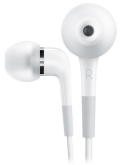
I've read the product info on the new headphones, and they look superb – I expect Apple's world-class engineering and design, along with neat features like the in-line mic. However, what I don't see is a SKU for black colouring, to match my iPhone – why not?
From the company that invented computers which are not grey in colour, and that get colour makes a difference when done right, why no black? Or is this just a delay in supply that is going to see a new colour variant pop up in 6 months?
IntoMobile should have hold of these new headphones for a proper review soon, but for now, Apple, if you are listening, can we please have some colour variants other than white? White shows up dirt, ear wax, and all other grim substances far too easily!
Headset
|

“We are now seeing more and more handsets enter the market with video out capability,” said Lock. “We fully expect more new models from LG, Nokia, Samsung, and Sony Ericsson to be hitting the market with TV out in the next few weeks that will also work with our iWear headsets.
“With the enormous growth and interest in mobile video content, whether it is downloadable or streamed, from anyone of the hundreds of web-based video sources such as YouTube, BBC iPlayer, and podcasts from sites such as iTunes; there is no doubt that more people are watching more content on more devices,” he said.
All of the iWear video headsets are supplied with a cable that connects to the iPhone as well as the full iPod range. The Vuzix box also includes a lead that connects direct to the Nokia N95 and N96.
A further “video in” cable is included as standard by Vuzix, and this connects to the video out lead for HTC, LG, Samsung and Sony Ericsson handsets as well to popular games consoles such as the Nintendo Wii. These video out leads are either supplied with the phone or are available as an accessory direct from the manufacturer.
[For those in the UK:] Vuzix iWear personal headsets start at £129.99 and are available direct from Vuzix or from Amazon, Apple’s online store, Firebox, and Play.com. You can also buy iWear in selected 3 retail stores as well as from threeaccessories.co.uk.
Having tested Vuzix’s glasses, I can genuinely say they are a really nice piece of tech - something that as a traveller solves the eternal problem of straining my eyes my eyes to see a small screen, or lugging a laptop around - instead now you can have a BIG screen, portability, and use your Mobile - the best of all words! :-)
Headset
|

Vuzix, the company behind personal video iWear, today confirmed its latest products were compatible with an increasing range of mobile handsets as well as with an expanding library of mobile video content.
(Sidenote: I’ve posted on Vuzix before - check out here, here, and here, for more info)
“Vuzix headsets change the small mobile screen experience into a big screen event,” said David Lock, head of European operations. “Our iWear headsets create a virtual screen, up to 62” large, right in front of your eyes. It truly is the cinema in your pocket and now there is no shortage of material to watch.”
“Nokia’s N96 with the BBC iPlayer on board is just one high profile example of the sudden expansion in content and connectivity that is now available,” he added.
Lock confirmed that handsets such as HTC’s new Touch Pro, LG’s Viewty, the Nokia 6500, N95 and N96, and Samsung’s Innov8 & Omnia models - together of course with Apple’s iPhone, iPod Touch and the other iPod models - were all compatible with the full range of Vuzix personal video headsets, including the two latest models, the entry-level AV230XL and the widescreen AV310WS.
Headset
|

Sony Ericsson has just announced that it has joined Google-led Open Handset Alliance. No dates for the first devices were given, but we are sooo looking forward to the CES and Mobile World Congress when hopefully we'll see first Sony Ericsson Android handsets being unveiled.
Here's what Sony Ericsson's CVP and head of Creation and Development, Rikko Sakaguchi, said: "Sony Ericsson is excited to announce its membership of the Open Handset Alliance and confirm its intention to develop a handset based on the Android platform. We believe Sony Ericsson can bring a wealth of experience in making consumer focused multimedia handsets with new user experience to the Alliance drawing on the successes of the Walkman and Cyber-shot sub-brands. Sony Ericsson is a strong supporter of open operating systems and we believe the Open Handset Alliance offers an exciting opportunity for a new and unique user experience only Sony Ericsson can deliver."
The official release also stats that the Open Handset Alliance membership will complement the Swedish-Japanese handset maker's existing Open OS strategy which is based on the Symbian and Windows Mobile platforms. Meaning, they'll keep pushing multiple platforms, at least for the time being.
Kogan, the Australian company that has electronics custom manufactured in China is going to come out with a very solid looking and featureful mobile phone named Kogan Agora Pro Mobile. We are very excited to hear that the Kogan Agora Pro has popped up in Australia as the latest Android handset and is available for international pre-order.

For $399 you will be getting a business-like Android smartphone fully equipped with a 2.5-inch resistive touchscreen, 3G data network and full QWERTY keyboard. Taking a good long look at what customers want at a price they can afford, Kogan has managed to deliver a very beautiful handset. This smartphone has GPS, 624 MHz processor, 128 MB RAM, 2-megapixel camera and Wi-Fi.
Its android so pre-installed software applications provide access to many services including GMail ™, Google Calendar ™, Google Maps ™, Google Talk ™, and a YouTube ™ video player. The integrated Google Maps™ application supports detailed map, satellite, traffic, and the new street view. The fully customizable home screen lets you put all the tools and gadgets you want at your finger tips. These handsets won't make it in time for Christmas though, as they're only ship from January 29th onwards

The Motorola S9-HD is a stylish, yet subdued headset, clad mostly in a rubberized matte black plastic exterior. There are two small strips of black chrome on each side of the antenna bump on the back of the headphones. The Motorola S9-HD came to us with an AC wall charger, a handy carrying pouch, and a set of user-changeable rubber eargels. We also had an iPod connector in the package to allow for wireless listening to our iPod Touch. There are 2 sets of large eargels, with a loose outer layer that seals off your ear, to keep background noise out and the music in. The other set is smaller, and lacks the loose outer part, thus making the S9-HD a bit safer for joggers who still need to be aware of their surroundings.
The Motorola S9-HD headphones wrap easily and nicely around the back of your head, with each earpiece resting comfortably in each ear. Control buttons for the S9-HD are found easily on both sides of the headphones, and are nicely arranged in a column containing 3 buttons each. On the right earpiece you'll find the music controls - forward, reverse, and play/pause. The left earpiece, then, provides the up and down volume controls as well as the call button.
The power button and mini-USB charging port are located at the back of the Motorola S9, on the underside of the antenna bump. The mini-USB port is covered by a rubber flap to keep moisture and debris out. The LED notification light is centered in the middle of the antenna lump, between the power button and charging port. The arms of the headset are made of slightly bendable plastic, so that it can easily stretch to accommodate users' heads.
The Motorola S9-HD weighs in at a barely-there 38g (1.3oz), which makes a difference when you wear them for extended periods of time. I was able to wear the S9-HD for hours, listening to music without experiencing any discomfort at all. The eargels are nice and soft, and there is just enough tension in the side arms to keep a firm fit, without causing ear fatigue or giving me a headache.
Setup and Use
The LED notification light at the back of the headset flashes blue slowly while the headset is powered on and connected to a phone or device. When you first power the S9-HD on, the light will flash blue three times, and will then turn solid blue to indicate 'pairing' mode. If you wish to reactivate pairing mode later, simply turn the headset off, and then press and hold the power button again until the LED shows solid blue. When you've successfully paired your headset with your cell phone, you'll see a blue light with 10 purple flashes.
When you have paired the Motorola S9-HD with your phone, you can simply press the call button on the left earpiece to answer or end a phone call. The play/pause button on the right earpiece can be used to reject the call. If your phone supports voice dial, you can activate this from standby simply by pressing the answer/hang up button. If you wish to simply redial the last number that you called, press and hold this button for a few seconds. While on a phone call, you can use the play/pause button to mute/unmute the headset's microphone.
The Motorola S9-HD supports multiple connections, so that, for instance, you could connect to your cell phone for calls, but connect to your Bluetooth-enabled computer for music. To do this, first pair your cell phone with the S9-HD, and then turn both your phone and the headset off. Now turn the headphones back on and put them into pairing mode. Follow the normal steps to pair your headset with your computer (or an iPod, if using the included adapter), and confirm that they are successfully paired. Now, turn the headphones off once again, and then turn both your phone and the Motorola S9-HD back on. The S9-HD should automatically reconnect to both devices.I was able to use the Motorola S9-HD's multi-point feature to listen to music from my Bluetooth-enabled laptop while still accepting calls on my Nokia N95. When a call came in, pressing the answer/hang up key automatically paused the music, and when I ended the call, the music automatically resumed playing.
As you would imagine, when you have the S9-HD connected to a music device, such as either your computer or a compatible cell phone, you can press the play/pause button to launch the music player. While this worked on my cell phone, it did not work properly on my Bluetooth-enabled laptop. Either way, once your music player is launched, the play/pause button on the Motorola S9-HD will allow you to control the music. You can press the forward button once to skip to the next track, or hold it for a few seconds to simply fast-forward through the track; likewise with the back button. These music controls worked perfectly with both my Nokia N95 and Winamp running on my laptop.
Although the Motorola S9-HD is sleek and stylish, that comes with a sacrifice in battery life. Motorola claims a battery life of only 6 hours talk or music playback time, which is actually less than most smaller, single-ear Bluetooth headsets. In my testing, 6 hours of music playback was accurate, though I did notice a slight increase in music playback time when using my computer for music, as opposed to my phone, which was slightly disappointing. Thankfully, the Motorola S9-HD recharges fully in 2 hours using the provided AC wall charger, and since the headset uses mini-USB, I was able to top it off using an open USB port on my computer, as well.
The Motorola S9-HD boasts a range of 30 feet, though in experience, this is an exaggeration. When paired with my phone (using both the Nokia N95 and the Palm Treo Pro, to avoid phone-specific bias) or the iPhone Touch, I found that the audio would cut out occasionally. For example, with the phone in my front pocket the audio would drop, but performed much better with the phone in my back pocket. Jogging with the phone or iPod in my hand was a slightly better experience, though there were still rare drop-outs there as well. Paired with my computer was a much better experience, and I was able to watch a movie with the S9-HD from roughly 10 feet away easily. Based on this, it appears as though the S9-HD performs better when there is a direct line-of-sight between the headset and the device.
Audio Quality
When listening to music, the Motorola S9-HD excels at producing high-quality music. The S9-HD features SRS WOW HD audio technology, which allows you to enjoy a digitally enhanced audio experience, with more full bass and better overall quality. You can enable/disable SRS WOW HD by pressing and holding the forward button, and there is a noticeable difference in quality. I enjoyed having the option, as well, since some music is better with enhanced bass, while others sounded better with SRS WOW HD disabled. I was also very pleased with the volume of the Motorola S9-HD, as well as the ability to keep music 'in', and background noise 'out'.
Unfortunately, while the Motorola S9-HD excels at music, it is an entirely different experience when attempting to chat with someone over the phone. Even indoors, callers reported a muffled sound, and there was often static on my end, even with perfect reception and using several different mobile phones. I tested the Motorola S9-HD inside a busy grocery store, and both callers simply asked me to call them back later. Similarly, the Motorola S9-HD failed the truck tests miserably, even with the windows rolled up. When using the headset for voice calls in an open area with wind, I was not able to understand the caller, and they were not able to understand anything I said, either.
Conclusion
As more and more cell phones support A2DP for stereo Bluetooth headsets, I'm glad to see Motorola attempting to streamline and stylize these headsets into something that you wouldn't be embarrassed to sport in public. The Motorola S9-HD is just that, with great music quality, extremely comfortable design, and easy to use controls. Unfortunately, the S9-HD falls a bit short when it comes to battery life and, more importantly, call quality. The S9-HD is mostly unusable for voice conversations. Based on this, we give the Motorola S9-HD a "Recommended" rating, with the warning that while they make tremendous music headphones, they shouldn't be relied upon for voice calls.
Well if you have a few mobile phones to launch you may as well launch a lot, and it appears Japan's NTT DoCoMo are doing just that, like 22 mobile phones being released between now and March 09.
Quite a few mobile phones then with the NTT DoCoMo range being…Style Series with 6 handsets- - Prime Series with 7 handsets- - Smart Series with 4 handsets - - and Pro Series with 5 handsets.

Most are old sliders or plain clamshells, but the Prime Series does have the Blackberry Bold, HTC Touch Pro, HTC Touch Diamond, Nokia E71 and the rip-off Touch Pro the Sharp On. For a full list of handsets hit up the source.
HTC went official with its latest product, the HTC MAX 4G, a hybrid between a normal Pocket PC and a WiMAX handset.
The MAX 4G is said to be the first integrated GSM/WiMAX device.
Resembling HTC Touch HD, the new handset will be exclusively released in Russia, by Scartel Yota, a leading provider of mobile WiMAX.
HTC MAX 4G runs on Windows Mobile 6.1 and uses the same TouchFlo 3D interface that HTC has embedded into all of its latest high-end devices.

Using the Yota Mobile WiMAX network, HTC MAX 4G can offer not only advanced telephony services, but also high-speed Internet access and high-quality multimedia services.

The full list of specs included in HTC's latest handset looks like this:
- 3.8 inch TFT touchscreen display with 480 x 800 pixels
- Tri-band GSM/GPRS/EDGE connectivity (900 / 1800 / 1900 MHz)
- GPS
- Wi-Fi, VoIP
- Proximity sensor
- Motion G-sensor
- 3.2MP autofocus camera
- Front-facing VGA camera
- Bluetooth 2.0
- Media player
- 3.5mm headset jack
- TV out
- FM radio
- 8GB of internal memory
- Weight: 151 grams
- Size: 113.5 x 63.1 x 13.9 millimeters

HTC MAX 4G will be on sale in Russia starting November 26. Its price is said to be somewhere around 28,900 Russian rubles ($1,050).

Klipsch has been a big name in the speaker game for years, and I remember the old school ProMedias as being the definitive article when it came to 2.1, and later 5.1, desktop sound. When I first reported the X5s I wasn’t sure they could possibly be much better than the other in-ears I’ve owned and loved. Boy, was I wrong. Simply put, these are easily the best in-ear headphones I’ve ever used.
For reference, I generally listen to music with in-ear, outside-sound-blocking headphones, my last pair being a pair of Shure e2c in-ears, which replaced a pair of perfectly decent Sonys before them. Now that I have a little perspective on things, I can see where each went wrong: the Sonys were indistinct and muddled the mid-high end. The Shures were clear as day but seriously lacked a low end. The X5s have no such problems.
I’ve had them for quite a while now (Sorry, Klipsch) and I’ve really put them through their paces. They’ve been tried on Zunes, iPods, phones, PCs, and Apples, and I’ve listened to all manner of music. The X5s have excelled on every platform, and exposed flaws in the music and sound systems I would never have caught with lesser headphones.
With my Shures, I tended to avoid music that relied on bass — not just hip hop and stuff like that, but any music with a lot of information at the the low end. Good bass playing, working the left side of the keyboard, that kind of thing. Now I’m positively seeking out songs with presence in every part of the register because I feel that I’m really hearing some of them for the first time. Grails’ Burning Off Impurities was a revelation, and Growing’s low end separated into distinct layers which were previously muffled by my subwoofer or ignored by my Shures. The X5s have absolutely excellent coverage. It goes without saying that you won’t feel the bass in your chest, but it’s punchy and right now on Deerhunter’s Cryptograms, I actually feel like someone is tapping (lightly) on the inside of my skull.
Tone balance is also excellent: although the bass is big, it’s totally transparent and the mids and highs punch right through. If there’s a weak point, I’d say it’s the mid-lows, which may not have the presence of the mids nor the power of the bass. The high end is easily as clear as my e2cs; as I write this I’m hearing a high hat crashing in the left channel of a song I listened to a ton with them, and it’s entirely new to me.
Like many in-ear headphones, the sound “space” is fantastic. Although I wouldn’t trust these over full-sized headphones for directional sound in games, music seems to take up your whole head. There is no feeling of the sound being shot into my ear from some external source like with external earbuds. They block outside noise well, but only as much as you’d expect from something that sits in your ear canal; they don’t make as much of a point of it as I feel Shure does (and follows through with). One bit of trouble I had (YMMV) was that the seal of the silicon with my ear was near perfect but not complete, which made the wind literally whistle through the tiny gaps here and there when I walked. It’s probably my mutant ears’ fault, but I’d say that if you really must have absolute isolation, be very picky about which tips you put on the things and how you stick them in your ears.
The phones themselves are tiny, and I must say, a bit weird-looking. Their form factor is such that they protrude somewhat from your ears. Not the most streamlined look, but you can be safe in your conviction that while someone else might have a cooler-looking pair, you’re getting a lot more out of your music. They come with several pairs of silicon ear-bits; my ears fit the default pair the best, but there are large and small pairs as well as double-flanged versions for those of you who are truly freakish. The cord is as you might expect, plain and a bit thinner than normal. The curved attachment looks cool and makes it harder to jerk the headphones out of their socket, although when events like that did happen (cord caught on a chair or what have you) they shot right out of my ears like bullets and their little flaps got inverted. The hole from which the music fires is extremely small and you will get earwax in it; luckily you can easily clean them out with a nice little tool they include or a pin, either of which fit comfortably in the very sweet little travelling case they come with.
Now comes the hardest part: admitting how expensive they are. Yes, it’s more than $100. Yes, it’s more than $200. Yes, they cost $250 and you probably won’t find them for less than that. Now, I want you to try to believe me when I tell you that these are worth every penny. I paid $100 for my Shures two years ago and was happy with them — the clarity and isolation were worth that at least, and these X5s are probably twice the headphones they are, and then you have a little luxury tax on top of that (what are you gonna do?). You can get them here from the Klipsch site if you feel like taking the plunge. I highly recommend it, your music won’t ever sound the same again.
Headset
|

The hf5 earphones have the same award winning technology as the hf2, but ditch the lame microphone. Tuned for a full dynamic range of sound coupled with the noise-isolating tips the hf5's let you hear everything without having to crank up the volume, which we all know isn't good for us. The hi-fi, noise-isolating earphones are available exclusively through Amazon and retail for $149.
Headset
|


